

Intro
Pitch Protocol
Shaping an AI experience to help investors find the companies worth backing
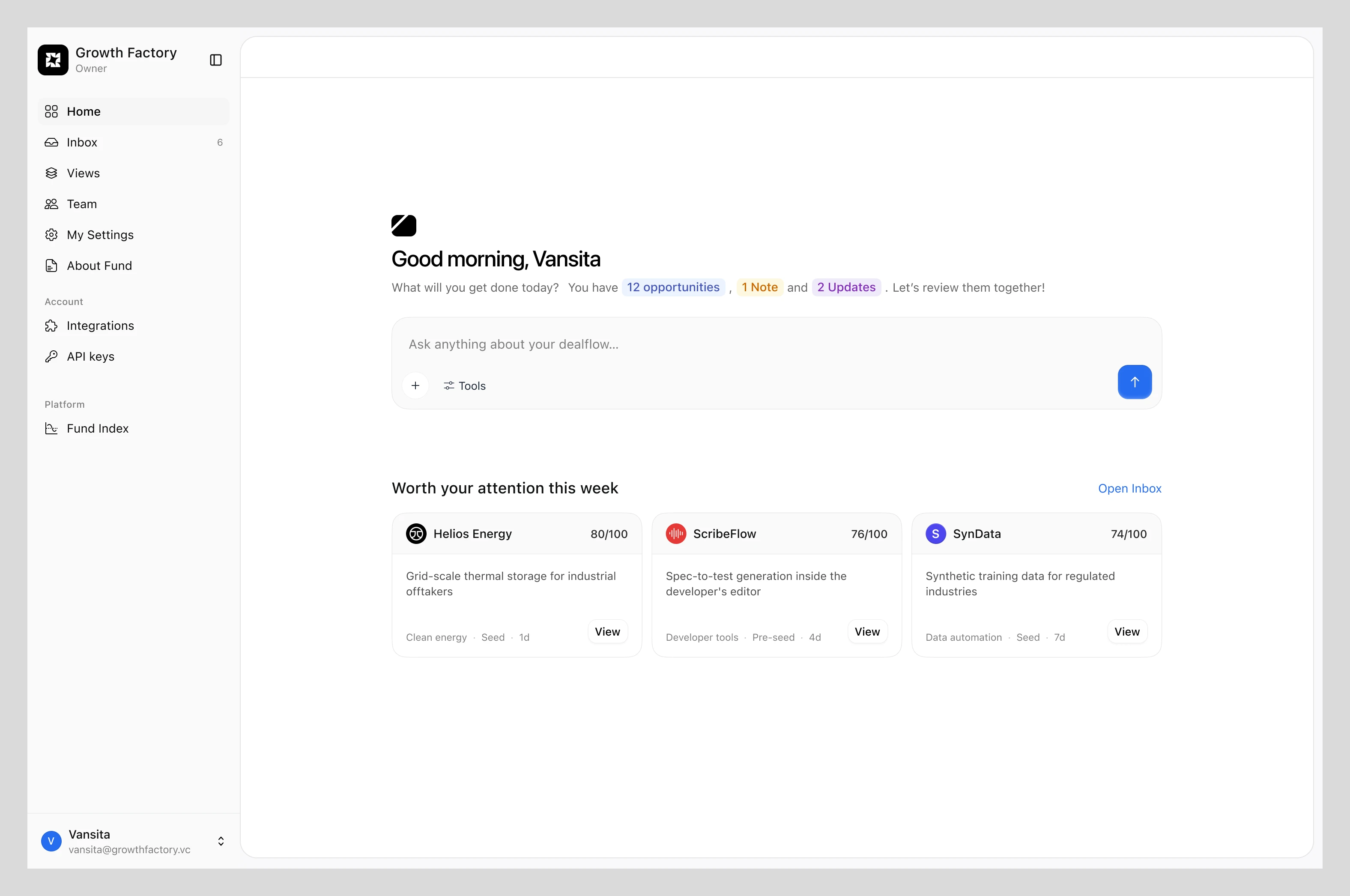
I joined Growth Factory Ventures about a year ago, initially working on the founder experience for Pitch Protocol. When the focus expanded to investors, I designed the experience to bring promising companies and the reasons behind the AI’s recommendations forward, so investors could decide more quickly and investigate further when they needed to.
- Scope
- UI/UX design, Brand, Website
- Team
- 1 Designer (Me), 1 CTO, 10 VCs
- Timeline
- 5 months


My focus
Pitch Protocol receives applications directly from founders seeking funding. It researches each company with AI and matches it with funds based on their investment criteria. This helps founders reach relevant investors and helps funds find companies with the potential to become strong investments. My focus was helping investors understand those matches and decide which companies are worth betting on.
I also helped build the internal admin dashboard, where the Pitch Protocol team manages funds and accesses developer debugging tools.
Project stage: the core investor experience is established and expanding, with a similar experience for founders as a future direction.

Problem
Finding promising companies meant working through too much information
Analysts would spend days researching a company. Pitch Protocol took on that work with AI, bringing founder materials and external research together into a detailed company assessment. But with hundreds of applications, investors still faced a huge amount of information to make sense of. My challenge was to help them see which companies deserved their attention and why, without having to piece together every finding themselves.

Research
Let investors shape what came first
I initially focused on making the full company report engaging and easy to follow. But as applications grew, feedback from the VC team changed the direction. Investors needed a quicker way to understand a company before deciding whether to read further.
The goal became giving investors 80% of the information they needed in 20% of the content, with the full report available when they wanted to dig deeper.
To decide what belonged in that snapshot, I spoke with VCs and grouped the AI’s research into related topics. In workshops, investors ranked what they needed first, what could wait, and what was missing. Their combined priorities shaped the snapshot, giving each information choice a reason.
The two goals behind the exercise
1. Understand what investors needed to make an initial decision.
2. Identify what was missing before choosing what belonged in the snapshot.
Insights
1. Some information could wait until an investor wanted to dig deeper
The rankings helped distinguish what investors needed for a first decision from what mattered during a closer review. Useful information did not all need to appear at once. Some findings belonged in the snapshot, while others could stay in the detailed report until an investor wanted to explore them.
2. Investors wanted different things from the same company
Some investors wanted revenue and metrics first. Others cared more about the founders and the problem they were solving. There was no single investor perspective to design around. A useful snapshot needed to reflect their shared priorities while leaving room for individual questions.
Ideation & feedback
Working through the experience with the team
After feedback that the company snapshot had too much text, I explored more visual versions. But much of the research was written explanation, and turning it into graphs took more space without making it clearer. I returned to a layout the team found easier to read, keeping concise text where it explained the company better.
Solution
Keep the evidence close to the recommendation
If the AI described a founding team as experienced, an investor needed a way to understand what supported that assessment. I explored opening a short preview of the supporting sources directly from the statement, with a path into the deeper research. This would let investors check the reasoning without losing their place. I also distinguished evidence strength from whether a finding was good news: strong evidence of a risk should not look like a positive endorsement.
Help the next person build on the research
I designed Notes around each company so investors could record observations, save useful AI answers, and return to them before a meeting. We kept individual decisions personal while making notes a place for shared discussion.
This gave teammates a shared place to see what had happened and what others thought about the company.
Make the next conversation easier to arrange
An investor wanting to meet the founders should be able to take that next step from the company they were reviewing. I connected Interested to sharing a scheduling link, with the link saved for future applications. The aim was to reduce the back-and-forth of arranging a call and avoid asking investors for the same setup each time.
Keep a useful comparison ready for next time
An investor might want to compare early-stage companies by revenue, while a colleague cared more about the teams. I designed Views as saved searches with a comparison table shaped around the investor’s criteria. They could adjust filters, benchmark companies on the factors that mattered to them, and save that setup. New applications matching the criteria could appear in the same View, so returning to the research would not mean rebuilding it.
Design System
Let the investigation follow the investor’s questions
The AI chat could help an investor compare several companies or investigate one in depth. A comparison might need a table, a question about revenue over time might need a chart, and a question about the founders might need a written explanation. I designed reusable response components within a shared design system, so the format could follow the question while the ways to read and interact with each answer stayed familiar.

Prototyping
A second search exposed a missing journey
Walking through the save flow revealed a conflict. I initially considered letting investors add new search results to an existing View. But a View for companies with paying customers would stop making sense if a later search added companies with no revenue yet.
That led me to separate creating a new View from deliberately editing an existing one. Investors could keep a consistent basis for their comparisons and change the criteria when they needed to. It also exposed a missing step in the flow, which was how to loosen a search that had become too restrictive.
Test the conversation beyond the first answer
I built an interactive prototype to try the AI experience as a conversation. For example, an investor could ask, “Show me promising AI companies,” then add, “Only those with revenue,” and follow with, “How strong are their teams?” Each question changed what they needed from the research.
Working through that sequence helped me design how one answer should lead into the next. When the company list narrowed or the comparison changed, the response needed to make that change understandable. I refined how the results updated so investors could keep investigating without losing track of the companies they were considering.
Outcome & reflection
Enough context to choose a next step
Investors were using the assessment to choose whom to meet. May from Growth Factory Ventures used the recommendations and scores to select companies and send scheduling links. Greg from The Bond Fund found the Pass / Take a meeting recommendations helpful for quickly deciding which companies deserved attention.
Product impact
15+ VC funds adopted Pitch Protocol and brought their teams onboard for shared company review. The platform received 1,500+ founder applications.
84% of applications matched at least one fund’s investment criteria, giving investors a relevant starting point.
Applications reached investors’ attention, with a median first look within 24 hours of submission.
About one in three submissions (34.2%) attracted interest from at least one fund.
What I’ll carry into the next project
Design around differences. Working with investors taught me to look for shared priorities while making room for different ways of thinking.
Give trust room to grow. Designing with AI made me more attentive to whether people could question an answer and understand its support.
Keep asking what happens next. I learned to test what happens after the AI gives an answer: can the investor refine the question, compare the options, and decide what to pursue? This helped me judge whether the experience supported a complete task.
I came into this project learning how investors think. My work became connecting the pieces into one experience: deep research, AI recommendations, and shared insights. I learned how to make AI feel like a natural part of an investor’s work: helping them recognize promising companies, reach decisions more easily, and build on each other’s thinking.